Surfcamp Costa Rica or Lombok? Why More Surfers Are Choosing Lombok
When planning a tropical surf holiday, Costa Rica is likely to appear in your search....


Stay Well Informed
Stay up to date with fresh insights, trends, and helpful advice from the DHM team.


Hello Sir only for demo content.
More articles by DHM
Share with your community!


You have never surfed before. Or maybe you tried once, got dragged across the sand by a whitewater wall, and quietly shelved the idea. Either way, you are reading this, which means part of you still wants to stand up on a wave. Lombok is where that happens.
This is the only guide you need before booking your first surf experience in Lombok. We cover exactly which spots are safe for beginners, what a real surf camp day looks like, how quickly you can expect to progress, what it costs, and why Lombok specifically beats Bali in every way that matters for someone learning to surf for the first time.
Bali gets the headlines, but experienced coaches will quietly tell you the same thing: Lombok is better for beginners. Here is why that is not just marketing.
Learning to surf requires repetition. The more waves you catch per session, the faster muscle memory builds. In Canggu or Kuta Bali during peak season, a beginner might wait 20 minutes between attempts competing with 40 to 60 surfers for the same crumbling wave. In Kuta Lombok, your instructor points you toward a wave, there is nobody in the way, and you go.
Want to understand exactly why Lombok beats Bali for learners? Our detailed comparison article, Why Travellers Choose Kuta Lombok Surf Over Bali, breaks down crowd levels, costs, and wave quality side by side.
Selong Belanak is one of the most consistently forgiving beach breaks in all of Indonesia. It has a sandy bottom with no reef cuts for beginners, a long slow-rolling wave that gives you time to complete your pop-up, and offshore conditions during the dry season that create clean, predictable faces.
At DHM Surf Camp in Kuta Lombok, beginners typically start at Selong Belanak before progressing to the boat-access breaks at Gerupuk Bay. The full breakdown of every Lombok surf spot is covered in our Lombok Surf Spots guide, which maps the south coast from beginner beaches to expert reef breaks.
Water temperature in Lombok stays between 27 and 30 degrees Celsius year-round. You surf in boardshorts or a swimsuit. No wetsuit, no cold shock, no stiffness. For a beginner already overwhelmed by learning a physically demanding new skill, not having to manage cold water makes a real difference to how long and how enjoyably you can stay in the water.
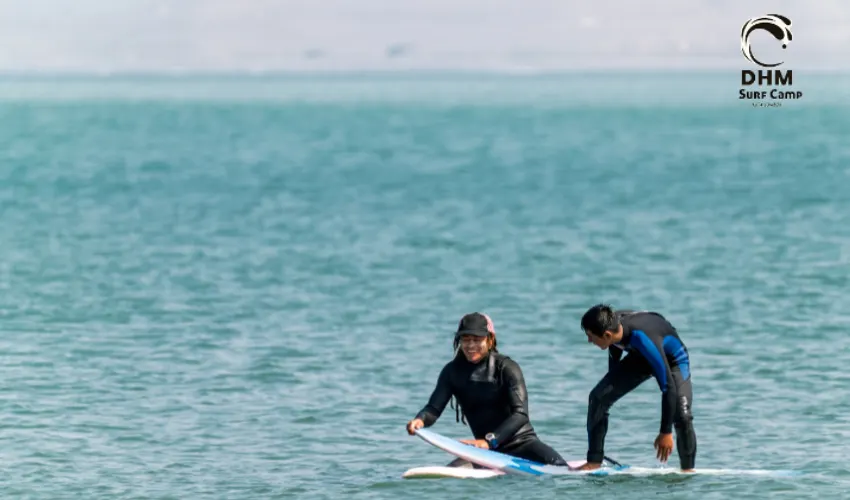
Located 20 minutes west of Kuta Lombok, Selong Belanak is a wide, sweeping bay with a sandy seafloor and waves that roll in slowly enough for a beginner to read, paddle into, and actually ride. Coaches from DHM Surf Camp regularly bring beginners here because the wave gives you time to pop up, find your balance, and ride for a few seconds rather than immediately wiping out.
Gerupuk Bay is a 15-minute scooter ride from Kuta Lombok, and within the bay sit seven distinct breaks accessible only by the traditional wooden jukungs (fishing boats). The inside break at Gerupuk is perfect for beginners who have had a few lessons and want to experience real green waves rather than just whitewater.
Gerupuk is covered in full in our guide, A Quick Expert Breakdown of Lombok Surfing in 7 Minutes, which explains every major break on the south coast and the swell conditions that make each one work.
Alternatively, there is Tanjung Aan beach, right next to Gerupuk Bay. This beach is also a beginners friendly wave perfect to start experiencing the surf in open water.
Every session starts on land. Your coach explains wave mechanics including how swells are generated, how waves break, and what whitewater is versus a green wave. You will practise your pop-up on the sand: the single motion of going from lying flat to standing in one fluid push. Coaches at DHM watch your pop-up closely, correcting foot placement, hand position, and weight distribution before you ever touch the water.
Most surf camps group beginners in cohorts of 6 to 10 people with one or two coaches split across the group. At DHM, the maximum ratio is one coach to two students.
This is the core difference at DHM. The article Why a Surf Camp Is the Best Way to Learn Surfing explains in detail why the coaching environment matters far more than the waves themselves when you are starting out.
After each water session, DHM coaches conduct photo and video analysis with students. You watch yourself surf. You see exactly what your coach is telling you: the late pop-up, the arms flailing for balance, the moment where you look down and lose it. Visual feedback accelerates learning dramatically because it converts abstract coaching notes into concrete, unmistakeable evidence of what needs to change.
If you are wondering whether age is a factor in how quickly you will progress, read our guide on surfing after 40 and whether it is too late to learn. The short answer is no, and DHM coaches people in their 40s and 50s regularly.
Lombok’s waves break over both sand and reef. For absolute beginners, coaches at DHM select sand-bottom breaks exclusively until students have sufficient board control. When you do progress to reef breaks, coaches teach falling technique specifically: fall flat and wide, not headfirst.
Rip currents are channels of water flowing back out to sea. Your DHM coach will point out rips before every session. If you ever feel caught in a current, do not paddle against it. Paddle sideways parallel to shore until you exit the rip, then paddle back in.
Lombok sits just south of the equator. Apply waterproof SPF 50 or higher before every session, reapply between sessions, and drink at least 2 to 3 litres of water on surf days. Rashguards provide UV protection from shoulder to wrist and are standard kit at DHM.
Browse DHM’s current surf packages, accommodation options, and what is included in every session on the DHM Surf Camp packages page. The booking process is straightforward and the team is available via the Contact Us page for any questions before you commit.
Surf, sun, and endless excitement await! Whether you’re a beginner or a pro, explore the world of surfing through tips, destinations, and breathtaking moments.
.png)