Bali to Lombok: Why Kuta Should Be Your Next Stop
Bali has earned its place on the Indonesian travel map. It has famous beaches and...


Stay Well Informed
Stay up to date with fresh insights, trends, and helpful advice from the DHM team.


Hello Sir only for demo content.
More articles by DHM
Share with your community!


Most beginner surfers paddle frantically for every wave that approaches, regardless of whether it is going to break cleanly or close out in a wall of whitewater. Learning to read waves is one of the most significant skill upgrades available to developing surfers. It takes time to develop, but these foundational concepts will transform how you approach every session.
Wave reading is a skill that compounds with time in the water. If you want to understand how different Lombok breaks present these wave reading challenges at different skill levels, our overview article Surfing in Lombok: Top Spots Suited to Beginners, Intermediates, and Pros is an excellent starting point before your first session.
Groundswell is energy generated by storms far out at sea, sometimes thousands of kilometres away. As this energy travels, the waves organise into defined sets with regular intervals (8 to 20 seconds between sets). Lombok’s dry season southwest swell is primarily groundswell, which is why Lombok waves are so rideable and predictable during the peak season. The full seasonal picture is explained in our Indonesia Surf: A Complete Guide for Your Next Surf Trip.
Wind swell is generated by local winds directly above the break. The waves are closer together (5 to 7 second intervals), choppier, and less organised. They break more unpredictably and are generally less surfable. Selong Belanak and Gerupuk in the afternoon can transition from clean morning groundswell to choppy wind swell. This is why DHM coaches consistently recommend morning sessions.
Waves arrive in sets: groups of 3 to 7 waves followed by a lull. The set waves are generally the most powerful and best-formed. The lull between sets is the opportunity to paddle out to the lineup. Learning to read the rhythm of sets at any given break is among the most practical skills for beginners: knowing a set is coming allows you to position yourself correctly before the first wave arrives.
The peak is where a wave first begins to break: the highest, most defined point where the wave pitches before rolling down the face. Positioning yourself at the peak gives you priority and the longest potential ride down the face. Positioning yourself too far to either side means you catch the wave after it has already been ridden by someone from the peak. That’s why out there in the ocean, eyes always should be in the peak!
Learning to identify the peak at any given break is a session-by-session process. At Selong Belanak, the peak shifts with tide and swell direction. Your DHM coach will point out peak position at the start of each session and give you real-time feedback on where to position yourself as conditions change.
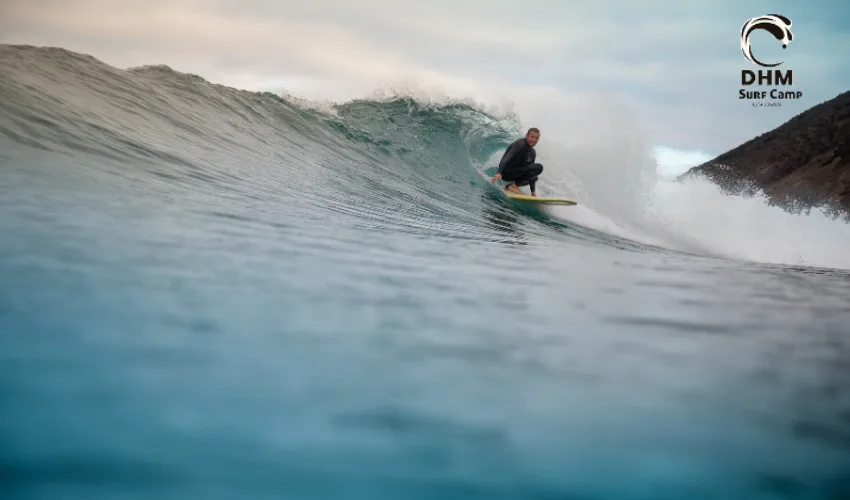
A close-out is a wave that breaks all at once across its full length rather than peeling progressively from peak to shoulder. Riding a close-out produces a very short ride because the wave wall collapses in front of you immediately. Close-outs typically occur on straight-on swells hitting a straight reef or sandbar. Peeling waves occur when swell arrives at an angle to the break, creating a progressively collapsing face that a surfer can ride along.
The same break behaves very differently depending on tide height. At low tide, reef breaks become shallower, waves break harder and more hollowly, and wipeouts carry more reef risk. At high tide, waves may not break at all over shallow sections. The sweet spot for most Lombok breaks is mid-tide. For how tide interacts with specific breaks on the south coast, our Indonesia Surf Itinerary: Plan the Ultimate Surf Trip guide covers session planning across a full week including tide considerations at each spot.
Wave reading develops fastest with daily coached sessions at the same break. Browse DHM’s coaching packages on the DHM Surf Camp packages page.
Surf, sun, and endless excitement await! Whether you’re a beginner or a pro, explore the world of surfing through tips, destinations, and breathtaking moments.
.png)