Surfcamp Costa Rica or Lombok? Why More Surfers Are Choosing Lombok
When planning a tropical surf holiday, Costa Rica is likely to appear in your search....


Stay Well Informed
Stay up to date with fresh insights, trends, and helpful advice from the DHM team.



Hello Sir only for demo content.
More articles by DHM
Share with your community!


Surf etiquette is not about being polite for its own sake. It is a practical safety system that prevents collisions, injuries, and territorial conflicts in shared water. Ignoring etiquette as a beginner creates genuine physical risk for you and others. Understanding the rules before you paddle out at any Lombok break makes your session safer, your coach happier, and the water community more welcoming to newcomers.
If you are brand new to surfing, read our Beginner’s Guide to Surfing Lombok first. That article covers what to expect from your first sessions at DHM before you need to think about shared lineup etiquette.
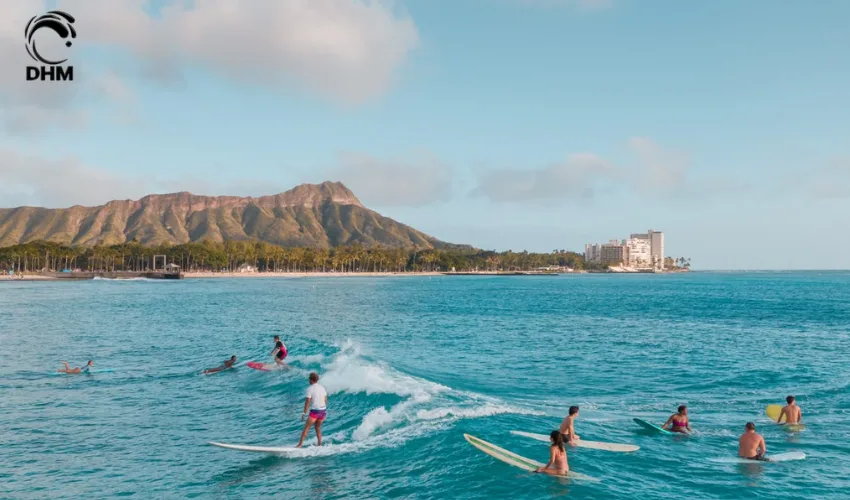
The surfer positioned deepest in the lineup, closest to where the wave is breaking first, has priority on any given wave. If two surfers paddle for the same wave and one is deeper (further from shore, at the top of the breaking wave), the deeper surfer has the right to that wave. The other surfer must pull back if the deeper surfer catches the wave. Nevertheless, if the deeper surfer misses catching the wave, this surfer loses priority and the next surfer in line gains the new priority. It is essential to observe and look at the peak of the wave all the time to learn about priority rules.
Each breaking wave belongs to one surfer. Exceptions exist: some waves have both a left and a right breaking from a central peak, in which case one surfer takes the left and one takes the right, splitting the peak. Only experienced surfers should attempt this; beginners should default to one wave, one surfer.
Dropping in, meaning paddling onto a wave that another surfer is already riding, is the most serious etiquette violation in surfing. A dropped-in surfer arrives in the path of the rider, forcing an evasive action that can result in board collision, fin lacerations, or wipeouts in dangerous sections. For beginners, drop-ins happen accidentally: you paddle for a wave without seeing the surfer already on it. The solution is to look both ways along the wave before committing to your paddle.
When paddling back out after a ride, you are crossing the path that other surfers are riding toward you on. The paddling surfer has the responsibility to avoid the riding surfer. Paddle around the break zone, using the channel (the area without breaking waves) to paddle out rather than cutting straight through the impact zone.
Understanding the physical layout of each break, including where the channel is located, is essential before paddling out. Our overview of Lombok Surf Spots covers the structure of every major south coast break so you can visualise the channel before you arrive.
When a wave breaks on you or you are overwhelmed, the natural panic response is to let go of your board and dive under. In a crowded lineup, your board becomes a projectile: a heavy fibreglass or foam object moving at speed through water where other surfers are positioned. The alternative is to hold your board and duck-dive under oncoming waves, or fall in a direction away from other surfers while keeping one hand on the leash. If ditching your board is the last option to do, make sure no one is behind, so no one could result in injury from the board ditched. In the same way, make sure to stay away from other surfers who might ditch their board without telling or warning other surfers. Additionally, make sure your board always faces the wave at a 90 degrees angle. This way, you will avoid the wave dragging or pulling the board harder behind.
Reef breaks like Outside Gerupuk, Mawi, and Ekas require honest self-assessment. DHM coaches control progression to reef breaks exactly because this assessment matters. For a detailed look at what Mawi and Outside Gerupuk require in terms of skill, our article Surfing in Lombok: A Raw, Real Wave Experience Beyond the Crowds gives an honest picture of what intermediate-to-advanced breaks here actually feel like.
When wiping out on a reef break, avoid diving headfirst. Spread your body wide and flat, maximising surface area, so you decelerate before reaching the reef rather than plunging through the water column and landing point-first on coral.
Reef booties provide a layer of protection against coral cuts during wipeouts and when walking on reefs. They are not standard kit at sand-bottom Selong Belanak but are strongly recommended before your first sessions at Gerupuk, Mawi, or Ekas.
Kuta Lombok’s surf community includes local Sasak surfers who surf these breaks daily. The relationship between tourists and local surfers in Lombok is generally positive, far warmer than in many more commercial surf destinations. Respecting the lineup, following the priority rules, and being patient rather than aggressive ensures this relationship stays that way.
Ready to learn in a coached, safe, etiquette-first environment? Browse available packages on the DHM Surf Camp packages page.
Surf, sun, and endless excitement await! Whether you’re a beginner or a pro, explore the world of surfing through tips, destinations, and breathtaking moments.
.png)